Latest News
Geography Writing Competition – closes 30 June 2025
Geography Writing Competition This is your opportunity to write a short story set in Queensland using imagination, creativity and with a wide interpretation. Opening date: 21 April 2025 Closing Date: […]
Various Queensland funding opportunities and awards
Check the websites of these earlier announcements for currency. Innovate to Grow program A self-paced and virtually delivered program designed to help small to medium sized businesses learn more about […]
The Prime Minister’s Prizes for Science
The Prime Minister’s Prizes for Science award Australian scientists and innovators with prizes to recognise outstanding achievements in science and research-based innovation. Closing date: Thursday 9 February 2023 5:00pm AEDT […]
Standing opportunities
Astronomical Association of Queensland
The Edward Corbould Research Fund of the AAQ was established in 1987 with a grant of $50,000. The fund is to support research projects by amateur astronomers. The Association welcomes interest from secondary school students and amateur astronomers who would like to contribute to astronomy, but are unsure about how to prepare a research proposal. Be not afraid! AAQ has experienced amateur astronomical researchers who would be only too happy to assist you. Make contact with AAQ and discuss what is possible.
Queensland Frog Society’s Public Trust Fund
Students and researchers from secondary and tertiary institutes can apply for grants through this fund. These grants fund research projects that aim to uncover valuable information and help better understand Queensland’s frogs, which would not be possible without financial support from the fund. Details can be found on the Ric Nattrass Research Grant page of the QFS website.
Australian Academy of Science Grant opportunities from the Australian Academy of Science.
Australian Wildlife Society University Grants.
Australian Citizen Science Association
Many citizen science projects generate information that should be preserved and made widely available, but don’t necessarily meet the restrictive criteria for scholarly scientific publication. Citizen scientists and naturalists can browse the attached guide Publishing Opportunities on how to choose an outlet for their material. For more detail see the page on Sharing Scientific Information
Would you like to publish your citizen science research in an open access journal for maximum public benefit but can’t quite afford the fees? There are no author charges to publish in the Proceedings of The Royal Society of Queensland, an open access journal.
Commonwealth Government
Grant opportunities from the Commonwealth Government.
Landcare
The periodic newsletter of Queensland Water and Land Carers includes announcements of grants in the landcare and environmental restoration fields.
Related Images:
The World Science Festival is hosted by Queensland Museum by arrangement with the pioneers in the USA.
The Deception Bay Environmental Hub is organising a major presence on behalf of citizen science at the 2026 Festival. Its flyer explains the activities available.
Related Images:

Dan Daly, an officer of the Department of Primary Industries, compiled this critique of drought policy after being transferred to the Department’s Drought Secretariat. Qualified originally in agriculture and latterly in economics, his analysis was inconsistent with the conventional wisdom of the day.
” The potential for a drought begins on the first day after rain. As dry day follows dry day, the possibility of a drought developing increases. It can become difficult to distinguish
between ‘normal weather’ and ‘drought’. The distinction between what is normal and what is not blurs with each passing day.”
Society President Charles Nason was acquainted with Dan Daly. “Dan Daly was brave enough to speak out about his concerns about drought subsidies , was stood down as a result… It took a brave man to speak up in Qld those days.”
Mr Day was removed from the Secretariat in 1989 and his analysis came to an end. The book was published in 1994.
Related Images:

Help us shape the future of the Biodiversity Heritage Library
The Biodiversity Heritage Library (BHL) is at a turning point. After nearly two decades of calling the Smithsonian Institution home, BHL must transition to a new hosting structure beginning in January 2026. Since receiving that news, we’ve been working steadily to secure a strong and sustainable future for BHL. In our last update, we shared the appointment of a Transition Director, the formation of a Transition Team, and a partnership with a fiscal sponsor.
Today, we release our official Call for Support. This is a pivotal moment in BHL’s journey, and we are counting on our community to help spread the word and contribute in whatever ways you can. BHL’s enduring strength comes from its international consortium and diverse community of scientists and citizen scientists who use the platform to explore, understand, and protect biodiversity. Support comes in many forms–some visible, some behind the scenes–but all are vital to BHL’s future.
Additionally, in keeping with our commitment to transparency, we are updating our Frequently Asked Questions (FAQs) to include information about the transition. New questions will be added regularly, so we encourage you to read and visit them often.
More About the Call for Support
🔗 Call for Support – Secure the Future of BHL
This global call invites partners to host or support BHL’s core roles, infrastructure, and services as we move through the next phase of our journey. From libraries and museums to universities, research centers, and nonprofit partners, we’re looking for new collaborators to carry BHL’s vital work forward.
We welcome support in the form of:
- Hosting key BHL roles or services (short- or long-term)
- Contributing in-kind support (e.g. staffing, infrastructure, expertise)
- Partnering on collaborative grants or funding proposals
- Providing financial support via our new fiscal sponsor
Key Dates
We encourage initial expressions of interest by 31 August 2025, with consideration continuing on a rolling basis.
Questions and expressions of interest can be directed to:
Kelli Trei, BHL Transition Director
Email: TransitionDirector@biodiversitylibrary.org
How You Can Help
Even if you or your institution isn’t in a position to provide financial or hosting support, you can still make a huge impact:
📢 Share this post and the Call for Support widely across your networks
🤝 Connect us with institutions, colleagues and funders who might want to get involved
💬 Contribute ideas: we welcome creative and collaborative proposals
🌱 Support BHL directly: Make a Donation
Together, We Can Secure BHL’s Future
For 20 years, BHL has given researchers, educators, and the public free access to centuries of biodiversity knowledge. With your help, we’ll ensure this incredible resource continues to thrive and grow for generations to come.
Related Images:
As the likelihood of legislation to limit clearing of native vegetation gained public notoriety in the late 1990s, and pre-emptory clearing accelerated, concern by rural landholders in particular about ‘property rights’ intensified. Heated meetings were held around the State. The Department of Natural Resources commissioned two significant consultancies and its own officers produced a significant internal report. These analyses lead to a government decision not to pay ‘compensation’ for newly imposed restrictions (which were of a regulatory and not proprietorial nature), but instead to establish funds for industry adjustment, property management planning and purchase of distressed enterprises.
Institutional Reform in Rural Australia: Defining and Allocating Property Rights, Tony Gleeson and Kirstie Piper, 2002.
Property Rights and Natural Resource Management, Ian Reeve, Institute of Rural Futures, 2002.
The Department’s internal paper was titled as if confined to property in water, but that was an artifact of late-stage internal negotiations; the analysis applies also to land.
In 2002 the Department commissioned eminent planner and lawyer Phil Day to produce an Issues Paper examining the concept of betterment – the taxing of the unlearned increment in value when government decisions and the general advance of a community result in a rising value of land. The paper – Incentives and Disincentives – the Potential of Property Taxes to Reinforce Public Policy Objectives wasn’t published but a copy has fallen from the back of a truck into QSN’s hands.
Maps of land use and land tenure in South-east Queensland:
Public land map – April 2008.
Map plus table.
Land use summary for the SEQ NRM region – June 2014.
In 2014 the Queensland Government published a Discussion Paper envisaging freeholding some of the public land estate. The Queensland Outdoor Recreation Federation (now Outdoors Queensland) commissioned a report titled Underpinning the Foundations of the Four Pillars. Queensland State Land–. A copy of the State’s Discussion Paper Strengthening our economic future has been annotated with detailed comments by QORF’s consultant.
Related Images:
Professor Hugh Possingham has been awarded one of the global scientific community’s highest honours with his election as a Fellow of the Royal Society.
A world-leading ecologist, Professor Possingham is one of 90 scientific experts from across the world who have been awarded fellowship of the London-based Royal Society this year. He was elected for his contributions to biological diversity and nature conservation, including his role in co-developing a leading conservation planning tool that is used in more than 180 countries.
Professor Possingham is currently a VC Senior Research Fellow in the University of Queensland’s School of the Environment, and he is an Affiliate of both the Centre for Marine Science and the Centre for Biodiversity and Conservation Science. He also served as Queensland’s Chief Scientist from 2020 to 2022.
The Fellowship of the Royal Society is made up of the world’s most eminent scientists,
engineers and technologists. Past Fellows include luminaries such as Isaac Newton, Stephen Hawking, Charles Darwin and Albert Einstein.
Related Images:
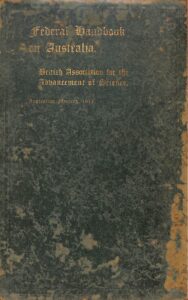
This remarkable book was produced by the British Association for the Advancement of Science in preparation for its “Australian Meeting 1914”. Not least of its remarkable features is a reference to The Royal Society of Queensland – on page 596, in the fifth volume – including a record of the number of members and the number of books in its library!
QSN has arranged scanning of the book and has uploaded it in five files because of their size. all have been rendered “searchable” though the search function is imperfect.
Federal Handbook A, pages i-209 – History, Aboriginals, Geology, Climate, Vegetation – 61 MB.
Federal Handbook B, pages 210-390 – Geology, Astronomy, Geodesy – 47 MB.
Federal Handbook C, pages 391-462 – Pastoral, Agricultural, Mining – 19 MB.
Federal Handbook D, pages 463-508 – Commercial – 16 MB.
Federal Handbook E, pages 509-598 – Education, Political, Miscellaneous – 32 MB.
Related Images:
At the time of drafting this post (April 2025), there seems to be no end of distressing news about loss of scientific knowledge, disbandment of scientific institutions and abandonment of knowledge-generating projects. So QSN has decided to open a page to accommodate some benchmark writings on the subject.
Two landmark documents in this field were published in the Proceedings of The Royal Society of Queensland in volume 124 of 2020:
Creating and then abolishing bodies of scientific knowledge, expertise and analytical capability: An Australian political malaise, by the late David Marlow, a member of the Royal Society of Queensland at the time.
Processes and institutions for scientific independence – Reflections on Land & Water Australia, by Jason Alexandra, highlighting the appalling decision to destroy one of the few national bodies aiming to reach across disciplinary boundaries to produce integrated analysis.
Society member Dr Geoff Edwards has written a few articles on the importance of knowledge in the series of opinion pieces Prevention or Patch-up? as contributions to a project by the Royal Societies of Australia on preventative health. Look especially for the first article on 28 February 2024; and the article “Prevention or patch-up? Data, information, and knowledge are not ‘wisdom’”on 8 May 2024; and on 1 May 2025 a critique of the political platform that would see large numbers cut from the Australian Public Service.
An opinion piece was published in the Times Higher Education on 24 April by Rhodri Davies and Dorrit Jacob:
“Earth science is critical to national resilience – so why is it being gutted? Australia must fund its universities in ways that reflect their mission – not just their margins”.
Related Images:
 Dr Felicity Cutten is a scientist and freelance writer who has published popular science, short stories, poetry and short fiction. She has a PhD from McGill University, Montreal, Canada and was Assistant Professor of Entomology at its agricultural college for seven years. This was followed by thirty years of teaching senior biology and general science in New Zealand. She worked for six years as field assistant with geologists mapping landforms in outback Western Australia. She has also developed an olive orchard. She has a life-long interest in the natural sciences, ecology and the effects of human activities on the natural world.
In late 2024 she visited Norfolk Island and recorded her observations in this charming report – part natural history, part travelogue, part commentary on local affairs.
(Norfolk Island is administered by the Commonwealth of Australia. Health and education services are provided by the Queensland Government under contract to the Commonwealth. It is deemed by The Royal Society of Queensland to lie within Queensland for the purpose of publishing scientific articles).
Related Images:

Reef Ecologic specialises in providing expert advice to design and implement innovative solutions to environmental challenges facing tropical marine ecosystems and the people who love and depend upon them. Reef Ecologic brings more than 40 years of experience at the leading edge of coral reefs science, management and policy to provide insight, guide strategic actions and build capacity among the leaders of today and tomorrow.
Reef Ecologic is a commercial firm. Read its capability statement here.
14 Cleveland Terrace
Townsville QLD 4810
p: 0418 726 584
ABN 66 601 301 099